


Views: 0 Author: Site Editor Publish Time: 2026-08-19 Origin: Site


If you have visited a modern trade show, retail store, conference, or branded event, you have probably seen a large illuminated fabric wall with smooth, edge-to-edge graphics.In many cases, these displays are SEG lightboxs.
A SEG lightbox, or Silicone Edge Graphics lightbox, is a backlit fabric display system that combines a reusable frame, tensioned silicone-edge fabric graphics, and integrated illumination to create a clean, seamless visual presentation.
At SEGQUICK, our 120mm modular SEG lightbox range is built around two main systems:
120mm SEGQuick Pro R1 LIGHTBOX — an aluminum modular SEG lightbox system designed for strong structural stability, reusable booth configurations, and professional exhibition applications.
120mm SEGQUICK ULTRA LIGHTWEIGHT LIGHTBOX R2 — a lighter modular system developed for easier transportation, flexible expansion, and efficient setup. R2 is available in two separate material versions: Aluminum R2 and PVC R2.
Both SEGQuick Pro SEGQuick Pro R1 LIGHTBOX LIGHTBOX and SEGQUICK ULTRA LIGHTWEIGHT LIGHTBOX R2 are modular SEG display systems, but they use different design approaches. SEGQuick Pro R1 LIGHTBOX is based on standardized geometric modules that can be combined into different booth layouts, while R2 focuses more heavily on lightweight construction, extendable sections, and connector-based configurations.
This means a modern SEG lightbox is no longer limited to a single illuminated advertising wall. With the right modular system, SEG lightboxes can be developed into:
Trade show backwalls
Complete exhibition booths
Reception counters
Retail displays
Arches and entrances
Storage rooms
Product merchandising structures
Custom branded environments

In this guide, we will explain what a SEG lightbox is, how silicone edge graphics work, why SEG displays are popular for trade shows and retail environments, and how different modular systems such as SEGQUICK SEGQuick Pro R1 LIGHTBOX and SEGQUICK ULTRA LIGHTWEIGHT LIGHTBOX R2 can be used for professional display projects.
A SEG lightbox, or Silicone Edge Graphics lightbox, is an illuminated display that holds a tensioned fabric graphic inside a specially designed frame.
A thin silicone strip is sewn around the perimeter of the printed fabric. During installation, this silicone edge is pressed into a narrow channel around the frame.
Once all four sides are inserted, the graphic is held under tension, creating a smooth and wrinkle-free display surface.
The result is a modern display with:
Edge-to-edge fabric graphics
Minimal visible hardware
Bright illuminated branding
Replaceable graphics
A reusable frame
A clean architectural appearance
SEG lightboxes are commonly used for trade shows, exhibitions, retail stores, showrooms, corporate environments, events, and brand activations.
SEG stands for Silicone Edge Graphics.
The term describes the fabric graphic itself.
A SEG graphic normally consists of:
A printed fabric graphic
A thin silicone strip sewn around the edges
A frame with a matching SEG channel
The silicone strip is inserted into the frame channel, which stretches the fabric across the front of the display.
Unlike rigid panels, adhesive graphics, or banners attached with hooks and fasteners, SEG graphics can be removed and replaced while the main display structure is reused.
This is particularly useful for companies that attend multiple events but regularly change campaigns, products, or branding.
Although the finished display can look like a permanent architectural wall, the operating principle is relatively simple.
The frame sections are assembled into the required size and shape.
Depending on the system, the structure may consist of individual profiles, standardized modules, or connected lightbox sections.
Professional exhibition systems are often designed for tool-free or simplified assembly to reduce installation time on site.
For illuminated models, the lighting and power components are integrated into the lightbox system.
Once the frame is assembled and connected to power, illumination is distributed behind or through the graphic to create an even visual effect.
The silicone edge of the fabric graphic is inserted into the frame channel.
Installers normally begin with the corners and then work around the perimeter.
As the silicone edge is inserted into all sides of the frame, the graphic becomes tensioned.
The final result is a flat, smooth display surface with very little visible hardware.
A professional SEG lightbox generally contains several key components.
The frame provides the structural foundation of the system.
Depending on the product and application, different frame depths and materials may be used.
For example, SEGQUICK offers 60mm, 65mm, 80mm, and 120mm SEG lightbox systems for different display requirements.
Smaller profiles are suitable for compact displays and retail applications, while deeper 120mm systems are better suited to larger freestanding displays and modular exhibition structures.
The fabric graphic provides the visible branding surface.
Because the silicone edge is concealed inside the frame, the graphic can cover almost the entire visible front area.
This creates the characteristic seamless appearance associated with SEG displays.
The lighting system is built into the display structure to illuminate the graphic.
A properly engineered lightbox should provide consistent brightness across the graphic while avoiding obvious dark areas.
Larger modular systems may also use:
Support poles
Corner parts
Middle connectors
Feet
Structural connectors
Angle connectors
Functional accessories
These components allow a simple lightbox to become part of a much larger exhibition system.
SEG lightboxes solve several problems that exhibitors and display companies regularly face.
Trade show halls are crowded environments.
Hundreds of exhibitors may compete for attention at the same time, making visual differentiation important.
Illuminated fabric graphics increase visibility and help brand imagery stand out from conventional non-illuminated walls and banner stands.
A correctly installed SEG graphic creates a smooth surface without exposed graphic fasteners.
The result can look closer to a custom architectural display than a traditional portable exhibition stand.
The same frame can be used with different fabric graphics.
For companies that exhibit regularly, this means the hardware can remain in service while graphics are updated for:
New products
Different events
Seasonal campaigns
Rebranding
Different customers
A well-designed SEG frame can be assembled and used repeatedly.
This makes SEG systems particularly attractive to:
Trade show contractors
Display distributors
Rental companies
Event agencies
Frequent exhibitors
Fabric graphics can be folded for transportation, while modular frame systems can be broken down into more manageable sections.
Compared with many traditional custom-built booth structures, this can significantly simplify logistics.
Feature | SEG Lightbox | Traditional Panel Display | Banner Stand |
|---|---|---|---|
Graphic Surface | Tensioned fabric | Rigid graphic | Roll or fabric graphic |
Illumination | Available / integrated | Usually separate | Usually none |
Appearance | Seamless | Visible panel joints possible | Portable display look |
Graphic Replacement | Easy | Depends on system | Easy |
Reusability | High | Varies | High |
Large Booth Capability | Excellent with modular systems | Possible | Limited |
Modular Expansion | High on professional systems | Varies | Low |
Transport Efficiency | Good | Often bulkier | Excellent |
A banner stand may still be the better choice when maximum portability and minimum cost are the priorities.
However, when visual impact, modularity, and booth-building capability are more important, SEG lightboxes provide significantly more flexibility.
SEG lightboxes come in different frame depths, sizes, materials, and structural systems.
There is no single profile that is ideal for every project.

Slim SEG lightboxes are suitable for applications such as:
Retail promotions
Smaller freestanding displays
Brand walls
Showrooms
Compact event displays
Their thinner structure helps reduce overall size and weight.

An 80mm system offers additional structural depth while remaining relatively portable.
It can be a good option for medium-sized displays and event applications where more stability is required.

120mm systems provide greater structural depth and are particularly useful for:
Large freestanding lightboxes
Trade show backwalls
Modular booth systems
Large-format exhibition displays
More complex display configurations
But even within the 120mm category, different systems can work in very different ways.
SEGQuick Pro R1 LIGHTBOX and SEGQUICK ULTRA LIGHTWEIGHT LIGHTBOX R2 are good examples.

A modular SEG lightbox uses standardized components that can be reused in different configurations.
Instead of treating each booth as an entirely new custom structure, a modular system creates a library of reusable components.
The same inventory can then be configured into different:
Backwall widths
Corner layouts
Booth sizes
Counters
Product display areas
Architectural structures
For distributors and rental companies, this is important because the value of the system is not limited to a single event.
One group of components can potentially support many future projects.
However, not all modular SEG systems use the same modular philosophy.
SEGQuick Pro R1 LIGHTBOX and SEGQUICK ULTRA LIGHTWEIGHT LIGHTBOX R2 illustrate two different approaches.

SEGQuick Pro R1 LIGHTBOX is a 120mm aluminum SEG lightbox system designed around strength, freestanding stability, and standardized geometric modules.
Instead of building every booth from identical rectangular sections, the SEGQuick Pro R1 LIGHTBOX system uses different pre-designed module families.
These include:
A Series
B Series
C Series
D Series
G accessory / feature modules
Each series represents different widths, heights, or geometric configurations.
These modules can then be arranged together to create complete trade show environments.
For example, a booth configuration may combine several modules such as:
A1 + D1 + A1

or:
G3 + C1 + A3
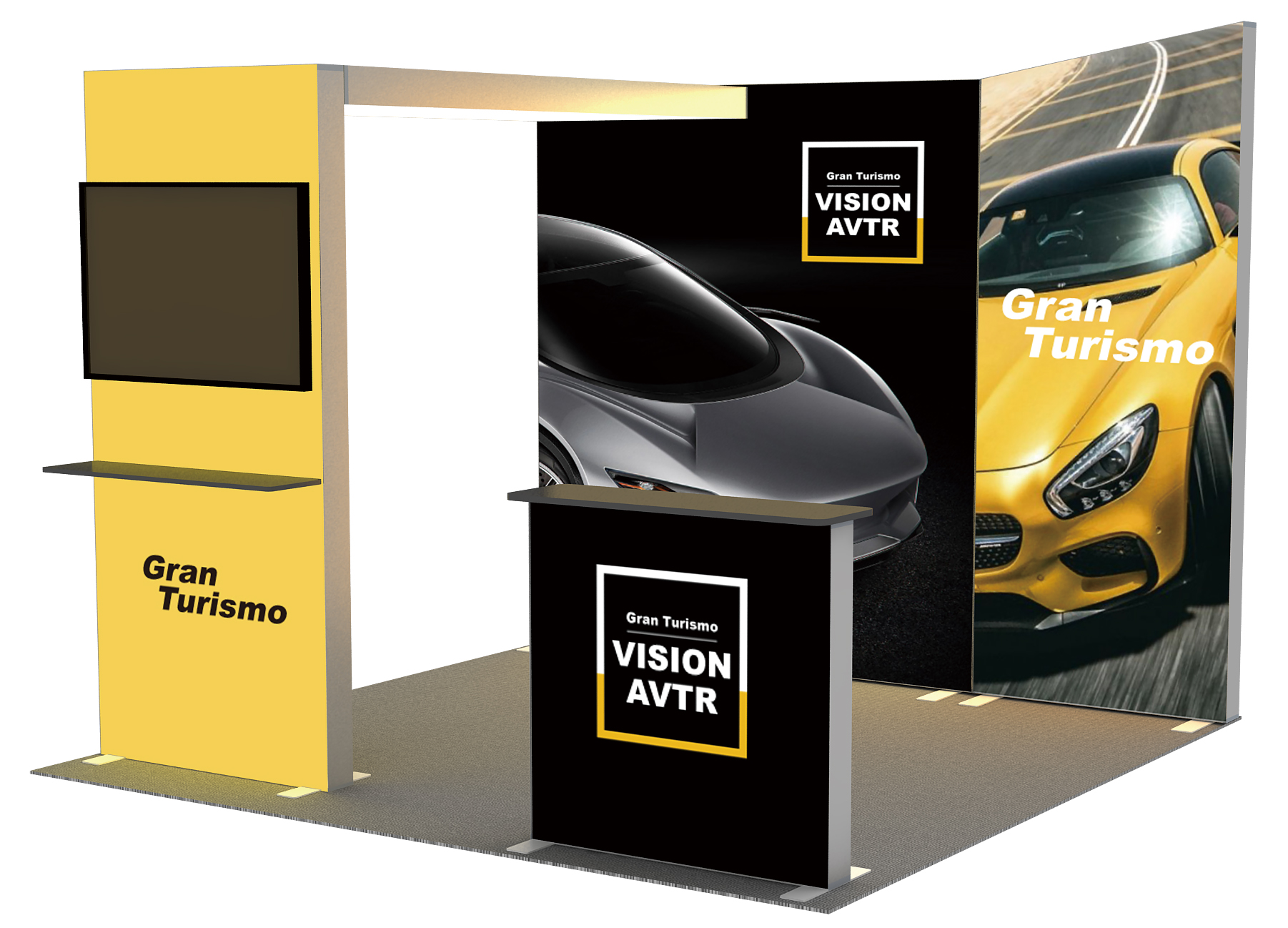
The important idea is that each part remains a standardized product.
The booth design changes according to how those modules are selected and positioned.
For a distributor or booth builder, this creates several advantages.
Instead of manufacturing every booth from scratch, common modules can be stocked and reused.
Different widths and geometric shapes allow designers to create layered and asymmetrical booth environments.
SEGQuick Pro R1 LIGHTBOX modules can be positioned as individual freestanding structures, making booth layouts easy to rearrange.
The 120mm aluminum structure provides the stability required for larger exhibition applications.
SEGQuick Pro R1 LIGHTBOX can be used for:
10×10ft exhibition booths
20×10ft booths
20×20ft booths
Large backwalls
Standalone illuminated towers
Feature walls
Reception areas
Custom modular layouts
In other words, SEGQuick Pro R1 LIGHTBOX is not simply a large 120mm lightbox.
It is a geometric modular booth-building system based on standardized aluminum lightbox modules.
SEGQUICK ULTRA LIGHTWEIGHT LIGHTBOX R2 takes a different approach.
R2 is also a 120mm modular SEG system, but it focuses more strongly on:
Lower weight
Easier transportation
Flexible connection
Expandable sections
Complex booth architecture
Another important difference is material choice.
R2 is available as:
PVC R2
and
Aluminum R2
These are two different material options rather than one mixed PVC-and-aluminum frame.
The PVC version is intended for applications where lower weight and cost efficiency are especially important.
The aluminum version offers a lighter alternative to R1 while retaining the advantages of an aluminum structure.
SEGQuick Pro R1 LIGHTBOX prioritizes solid aluminum construction and physical stability.
R2 was developed with weight and logistics efficiency as greater priorities.
This makes R2 particularly relevant for companies that:
Ship displays frequently
Manage rental inventory
Attend multiple events
Use air freight
Need easier handling
Want to reduce storage and transportation pressure
For distributors, total ownership cost is not only determined by the original purchase price.
Shipping, warehouse space, labor, drayage, and repeated handling can also become major costs.
A lighter modular system can therefore create significant operational value over multiple events.
R2 uses an expandable section-and-connector concept.
The system can use standardized sections to create different widths, allowing a smaller inventory to support multiple display sizes.
Rather than stocking completely separate 1m, 2m, 3m, 4m, 5m, and 6m displays, modular sections can be combined according to the project.
This is the principle behind R2's “No Stock Pressure” concept.
The same modular philosophy extends beyond straight walls.
Specialized connectors allow R2 components to create more complex structures.
R2 can be configured into much more than a traditional rectangular lightbox.
Multiple sections can form larger illuminated brand walls.
R2 components can be used to create 10×10ft, 20×10ft, and larger booth environments.
The modular frame can create enclosed or semi-enclosed areas inside an exhibition stand.
This allows booth designers to integrate practical storage space without introducing a completely separate construction system.
Connector accessories allow frames to create entrance structures and architectural booth elements.
The same design language can continue into reception or product demonstration counters.
Accessories such as shelving, hooks, merchandising poles, pegboards, and TV mounts can transform the lightbox structure into a product display system.
This is why a professional modular SEG system is better understood as a display platform, not simply a lightbox.
Both systems are modular 120mm SEG solutions, but they solve different problems.
Feature | SEGQuick Pro R1 LIGHTBOX | SEGQUICK ULTRA LIGHTWEIGHT LIGHTBOX R2 |
|---|---|---|
Frame Depth | 120mm | 120mm |
Material | Aluminum | PVC or Aluminum |
Weight | Heavier / more solid | Lighter |
Modular Principle | A/B/C/D/G geometric modules | Extendable sections + connectors |
Structure Style | Standalone modular placement | Connected modular architecture |
Main Strength | Stability and geometric booth design | Logistics and configuration flexibility |
Complex Connected Structures | More limited | Strong |
Storage Rooms / Arches | Possible through system design | Core system advantage |
Best For | Premium booth layouts and stable freestanding structures | Frequent transport and connected booth environments |
Neither system is universally “better.”
The right choice depends on how the display will be used.
Choose SEGQuick Pro R1 LIGHTBOX when the priority is:
Strong aluminum construction
Freestanding stability
Geometric module variety
Premium large-format booth presentation
Choose R2 when the priority is:
Lower weight
Easier logistics
Flexible size expansion
Connected booth structures
Storage rooms, arches, or multifunctional layouts
Exhibition setup time directly affects labor costs and project efficiency.
Modern SEG systems increasingly use tool-free connection methods because installers may need to assemble and dismantle displays many times throughout the year.
A tool-free system can help:
Reduce installation steps
Reduce dependence on specialist installers
Speed up booth setup
Simplify training for rental customers
Reduce the risk of missing tools on site
Both SEGQuick Pro R1 LIGHTBOX and SEGQUICK ULTRA LIGHTWEIGHT LIGHTBOX R2 are designed around simplified installation.
R2 further incorporates a built-in button design intended to improve handling during assembly and dismantling.
Packaging is easy to overlook when comparing display systems, but it has a significant impact on long-term operating costs.
Professional SEG systems may be transported dozens of times during their service life.
Good packaging should:
Protect frame components
Keep individual parts organized
Simplify transport
Reduce missing components
Make storage easier
Improve container and freight efficiency
SEGQuick Pro R1 LIGHTBOX can be supplied with different transport solutions depending on the application, including wheeled protective packaging and flight-case options.
R2 places even greater emphasis on compact, lightweight packaging as part of its logistics-focused design.
For wholesalers, rental companies, and international distributors, packaging efficiency can be almost as important as setup speed.
Yes.
Although SEG lightboxes are strongly associated with exhibitions, the same technology works well in retail environments.
Common retail applications include:
Illuminated promotional walls
Product launch areas
Store windows
Temporary pop-up shops
Branded merchandising zones
Cosmetic displays
Fashion displays
Electronics merchandising
Modular accessory systems can also add:
Shelves
Clothing rails
Hooks
Pegboards
TV mounts
This allows the illuminated wall itself to support merchandise rather than serving only as a background graphic.
Yes.
Reusability is one of the main reasons companies invest in SEG display systems.
The frame can be used repeatedly, while the graphic can be replaced whenever the marketing message changes.
A reusable system can therefore support:
Event 1: New product launch
Event 2: Corporate branding
Event 3: Distributor exhibition
Event 4: Seasonal promotion
The same hardware can remain in service while only the fabric graphics and layout change.
Modular systems increase this value even further because the same components can also be rearranged into different booth sizes.
Before buying a SEG lightbox, consider five questions.
A permanent retail display and a frequently transported trade show booth have very different requirements.
Smaller 60mm, 65mm, or 80mm systems may be sufficient for compact applications.
Large exhibition walls and booth systems often benefit from a deeper 120mm structure.
If the system travels frequently, weight and packaging deserve greater consideration.
If you use the same display size every time, a simple freestanding lightbox may be enough.
If booth dimensions regularly change, a modular system provides greater long-term value.
If future projects may require counters, shelves, storage spaces, arches, TV displays, or complete booth structures, choose a system with a developed accessory and connector ecosystem.
For professional resellers and display companies, the supplier behind the product matters as much as the product itself.
Consider whether the manufacturer can provide:
A strong product portfolio should cover different budgets and applications instead of forcing every customer into one profile.
Frame and fabric graphics should be engineered together to ensure correct tension and fit.
The supplier should understand complete booth systems, not just individual illuminated walls.
A developed accessory system increases what distributors can offer their customers.
Different markets may require bags, protective cases, or freight-oriented packaging.
For distributors, the ability to support custom dimensions, private-label projects, and specialized configurations can be important.
A SEG lightbox uses a fabric graphic with a silicone edge that fits into a dedicated frame channel. This creates a tensioned, seamless fabric surface that is easy to replace.
Not exactly.
“LED lightbox” describes the illumination technology, while “SEG lightbox” describes the graphic mounting method.
Many modern exhibition SEG lightboxes are also LED illuminated, so the terms often overlap in the display industry.
Yes. The graphic can be removed from the frame and replaced with a new printed SEG fabric.
Yes. Reusing the frame while replacing the graphics is one of the main advantages of the system.
SEG systems are available in many profile depths. ExpoMax's current range includes 60mm, 65mm, 80mm, and 120mm solutions for different applications.
Yes. Professional modular systems can be used to create backwalls, 10×10ft booths, 20×10ft booths, 20×20ft booths, and larger custom configurations.
SEGQuick Pro R1 LIGHTBOX is a 120mm aluminum system using standardized A/B/C/D/G geometric modules and emphasizing freestanding stability.
R2 is a lighter 120mm system available in PVC or aluminum versions. It uses expandable sections and connector accessories to create continuous walls, arches, storage rooms, counters, and complex booth layouts.
No. R2 is offered in separate PVC and aluminum frame versions.
Yes. R2 is designed as the lightweight alternative within the 120mm SEGQUICK range, while SEGQuick Pro R1 LIGHTBOX prioritizes more solid aluminum construction and stability.
No. They can also be used in retail, showrooms, conferences, corporate spaces, pop-up stores, and other branded environments.
Before placing an order, check:
Is the frame suitable for your required size?
Is the graphic true SEG fabric with a silicone edge?
Can graphics be replaced easily?
Is assembly tool-free or simplified?
Can the system be reused?
Is the system modular?
How does it pack for transportation?
What is the total shipping weight?
Are spare parts available?
Can accessories be added later?
Can the system grow into larger booth configurations?
Does the supplier support graphic production and custom projects?
For distributors and frequent exhibitors, the most important question may not be:
“How much does one lightbox cost?”
A better question is:
“How many different projects can I build with the same display system?”
A SEG lightbox is much more than an illuminated advertising frame.
At its simplest, it combines a reusable structure, a replaceable silicone-edge fabric graphic, and integrated illumination to create a clean, professional display.
But modern modular SEG systems take the concept much further.
They can turn standardized lightbox components into complete branded environments including:
Backwalls
Counters
Retail displays
Exhibition booths
Arches
Storage areas
Product merchandising systems
SEGQuick Pro R1 LIGHTBOX and SEGQUICK ULTRA LIGHTWEIGHT LIGHTBOX R2 demonstrate two different approaches to modular display design.
SEGQuick Pro R1 LIGHTBOX uses a stable 120mm aluminum structure and standardized A/B/C/D/G geometric modules to create flexible freestanding booth layouts.
R2 provides lighter PVC or aluminum options and a connector-based modular system designed for efficient transportation and more complex connected structures.
For exhibitors, distributors, and trade show professionals, choosing the right SEG lightbox is therefore not only about brightness or size.
It is about selecting a display system that can be transported efficiently, installed repeatedly, reconfigured for new projects, and continue creating value long after the first exhibition is over.


